NO TIME | NO PLACE
Need it matter where a photograph is created? Should latitude and longitude define nuance and design? Intrinsically Earth’s myriad marks and scratchings are volatile, fleeting, ephemeral. Some live for just a few hours, the waves and tides washing away their evidence. More resilient formations may span millennia, recognisable yet less ephemeral.
Searching below, we orchestrate fleeting moments of recognition, of choice, of delivery; when the structure of the landscape reveals a sense of shape, of design, an interpretation. These images need no precise waypoints. Indeed they may no longer exist. Maybe they never did.
For 40 years, Peter Eastway and Tony Hewitt have been immersed in the medium of photography, exploring projects together where their imagination and craft allow them to translate the clinical capture of a camera into a romantic or poetic expression.
What's it like at
Castello Ceconi
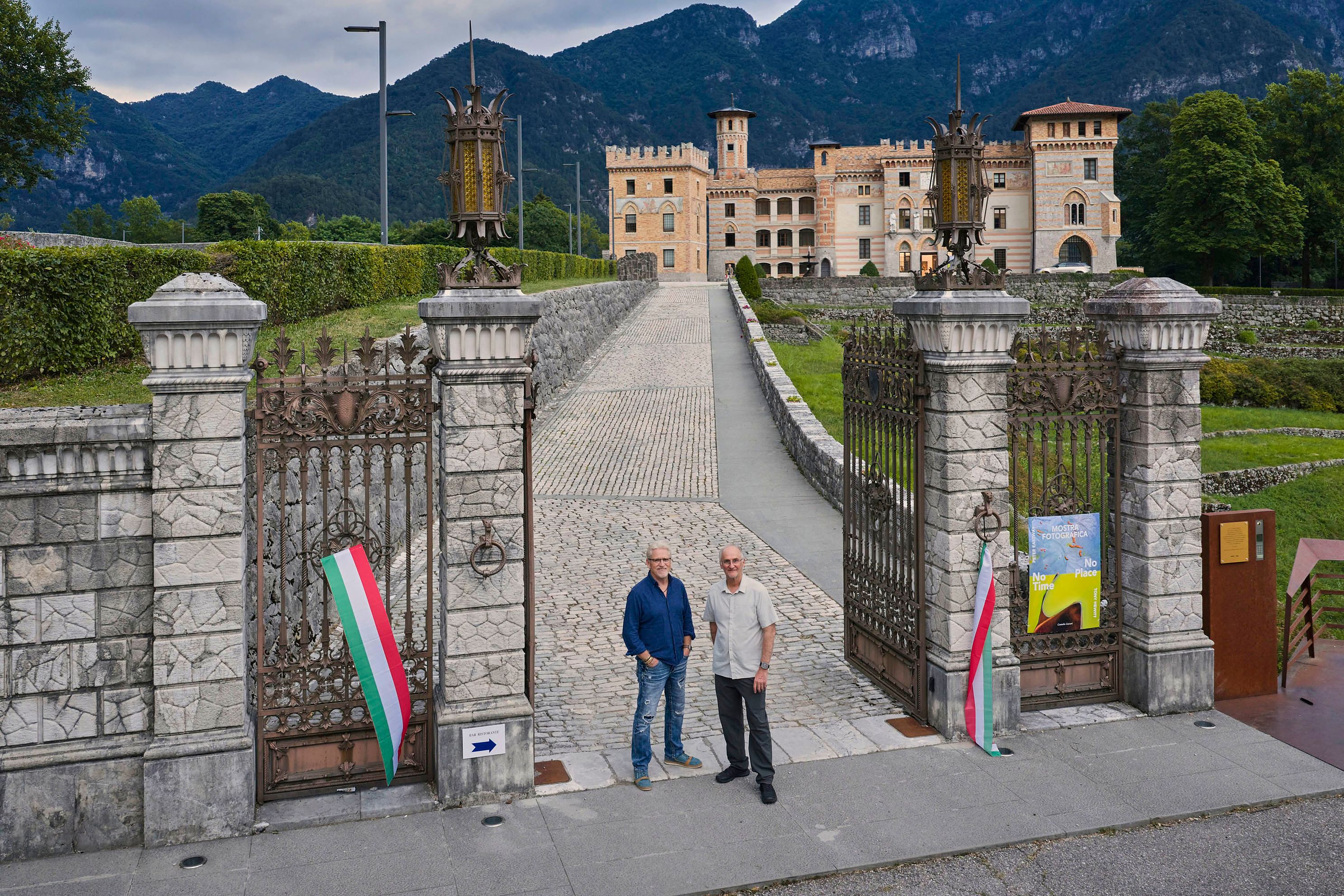
When you tell people you have an exhibition in a neo-Gothic castle, north of Venice and in the foothills of the Italian dolomites, you don't have to say much more. But that's really just a small part of the story. Castello Ceconi is located on a small plateau, deep within thick forests and surrounded by an amphitheatre of towering mountain peaks. It's an hour and half north of Venice, with the autostrada changing to increasingly narrow roads that wind and snake their way to a remote and luxurious oasis. As you emerge from the forest canopy, you pass through tall stone and iron gates, up a lengthy driveway and past a large circular fountain to an expansive forecourt. And there's not a sound around the extensive manicured gardens except for a distant church bell down in Pielungo, a couple of kilometres away. Inside and out, the castle has been fully restored by Graphistudio. The first and second floors now house six large rooms which form the gallery spaces. Downstairs is a fully equipped restaurant - so it's a perfect venue for an art gallery.
Why do you print on
Canson Infinity Paper
Photography's fundamental characteristics have been changed or lost with the advent of social media and portable devices. Most important for me is the enjoyment and appreciation of photography as an object of art. A photograph can be so much more than a fleeting collection of pixels on a shiny little screen - it can be a print. And a print can have size and there is nothing more impressive than a large photograph printed on thick, luxurious media with rich pigment ink where you can see the texture in the paper, the signature in the corner and the three-dimensionality of the surrounding frame. In this format, photography regains its original character and projects its true strengths. A photograph isn't just an image file, it's a physical print which adds size, texture and presence into the equation - and it's another means to further refine the artist's expression. Years ago I experimented with dozens of different paper types and brands. I learnt two things. First, I feel my photographs really sing on a flat matte surface where the strong hues of my files are rendered as elegant, tertiary colour values. And second, I just loved Canson Infinity's range of papers. Sure, they have a long legacy and sensational archival qualities, but it's the surface and the way the paper holds the ink that make Canson my choice. In fact, I love Canson's papers so much that today I'm a proud Canson ambassador.
What does the title of your exhibition mean, the
Random Nature of Intention
What does the random nature of intention mean? There is an element of the unknown and serendipity in what I capture. When I jump into a plane or a helicopter, I generally have an idea about what I want to find, or what I'm looking for - and generally when I am up in the air, I discover something unexpected, a scene or a phenomenon I hadn't considered. So, while my intentions can be quite specific, I am open to suggestions. I let serendipity plays its part and the longer I capture photographs, the more I recognise the value of accepting and embracing serendipity.
Similarly during the creative process that follows, I don’t always have a clear idea of what I want. Often it’s a process of exploration, not of the landscape below, but of the potential captured and now hidden within the pixels.
This is especially so with the current work where I am investigating the juxtaposition and interaction of separate elements, each with their own strengths and potential, but now coalesced into a new whole, a new vision. It is this highly intentional process that produces surprising and unpredictable results. For me they are random, even though I am very intentional in my application.